
The liquidity challenge hampering Europe’s tech ambitions


The strategic imperative
As we have seen in recent years, technological innovation is increasingly critical to economic growth and competitivity. European politicians and business leaders have awoken to the need to stimulate innovation and reduce dependency on US and Chinese technology. This has resulted in a total of more than €65bn1 of funding for European start-ups and growth companies which has resulted in a new generation of European champions including Mistral, Helsing and Quantum Systems. But funding innovation is only half the battle. Getting capital back to investors is where the system breaks down.
The liquidity problem — and why it matters
European investors often express scepticism about the ability of private technology managers to return capital to investors, citing the historic lack of liquidity that has impacted the industry. Indeed, on average, it takes more than 10 years for investors to recover the initial cost of their investment2.
This lack of liquidity is important since private markets run on a flywheel: investors commit to funds, capital is deployed, and distributions from exits are recycled into new commitments. Break one link in that chain, and the whole system seizes up. Investors stop committing to new funds, capital dries up, and the next generation of startups goes unfunded.
The lack of liquidity for technology investments is among the most significant challenges facing the Venture Capital industry.
In our view, the lack of liquidity for technology investments is among the most significant challenges facing the Venture Capital industry. Without a material increase in cash returned to investors, Europe will be unable to build a self-sustaining ecosystem — and the amount of capital invested will remain modest.
Public markets’ structural challenge
A key part of the problem is the difficulty for Europe’s public markets to attract both investors in IPOs as well as to convince company founders to go public.
As a result, Europe has seen virtually no significant technology listings since 2021. This has resulted in companies staying private for longer whilst the number of listed companies has halved over the past 30 years.
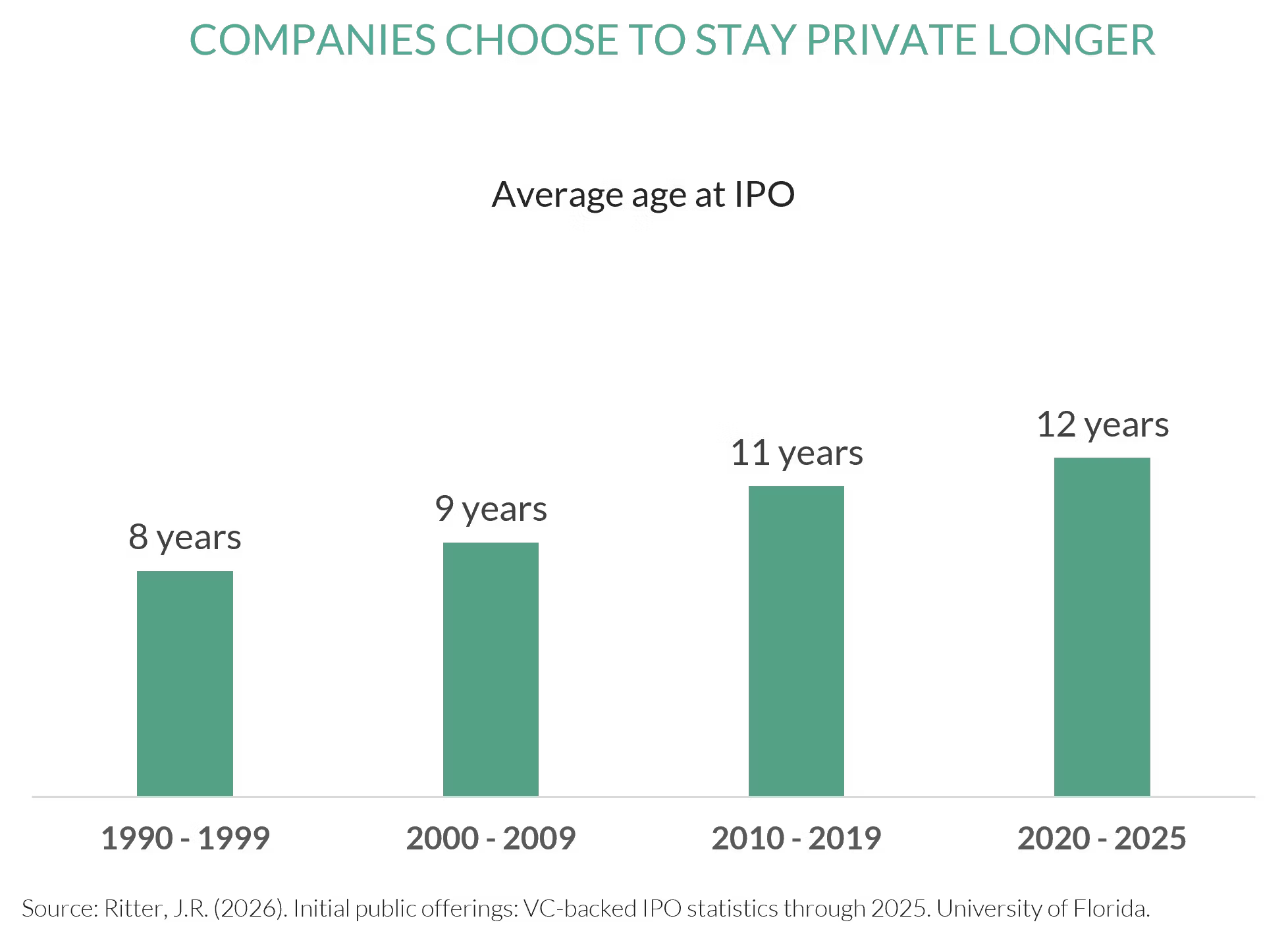
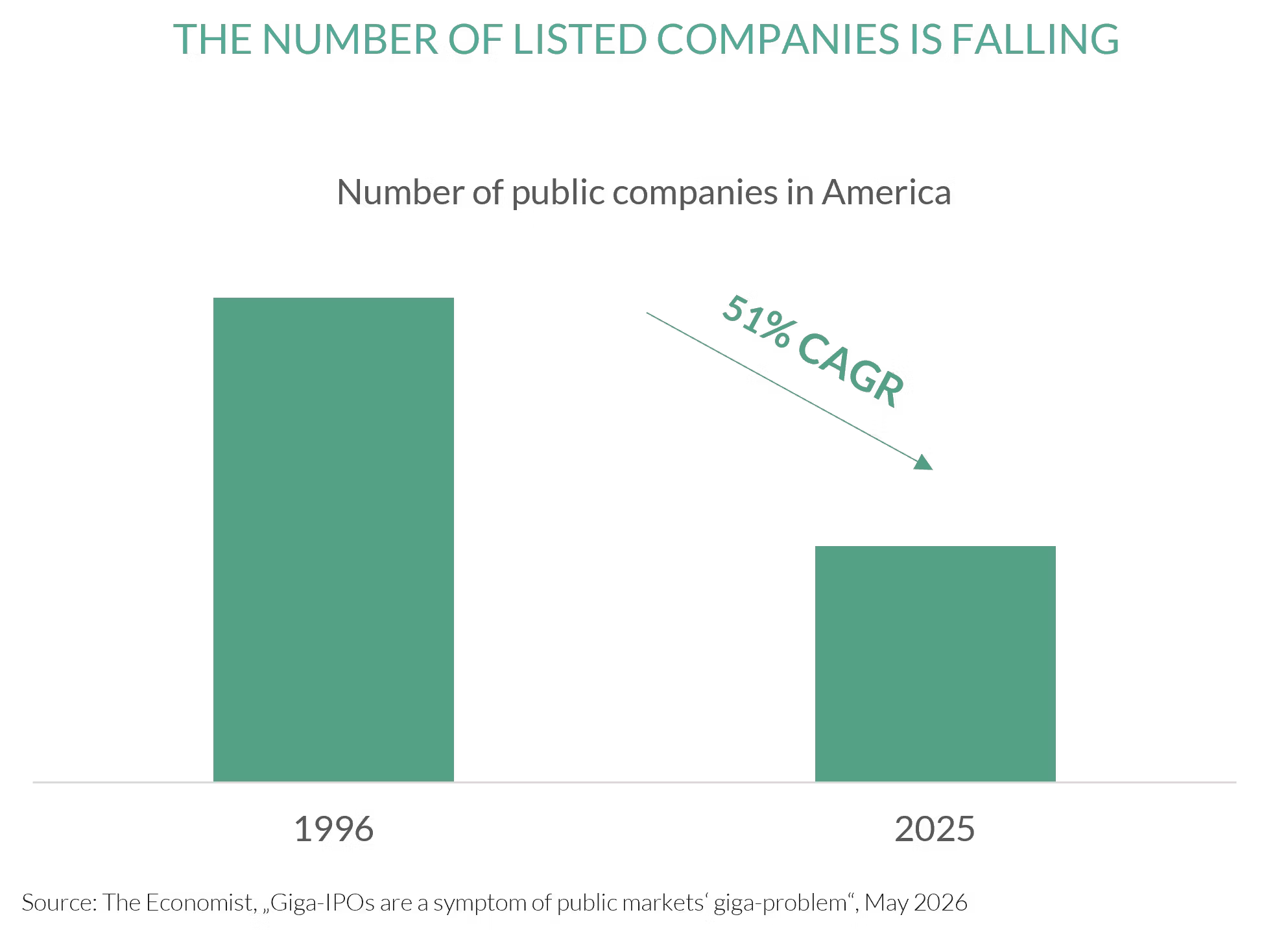
Whilst welcome, the much-awaited mega-IPOs are not the solution. Given the valuation of the companies at their IPO, private markets have already captured hundreds of billions of Euros of value. To match Amazon’s return since its 1997 IPO, SpaceX would need to reach a market cap of $470 trillion3.
The result is an estimated $4.6 trillion of unrealised value is currently locked in VC funds globally4 out of which we believe at least hundreds of billions are in Europe, preventing investors from recycling this capital into fresh commitments.
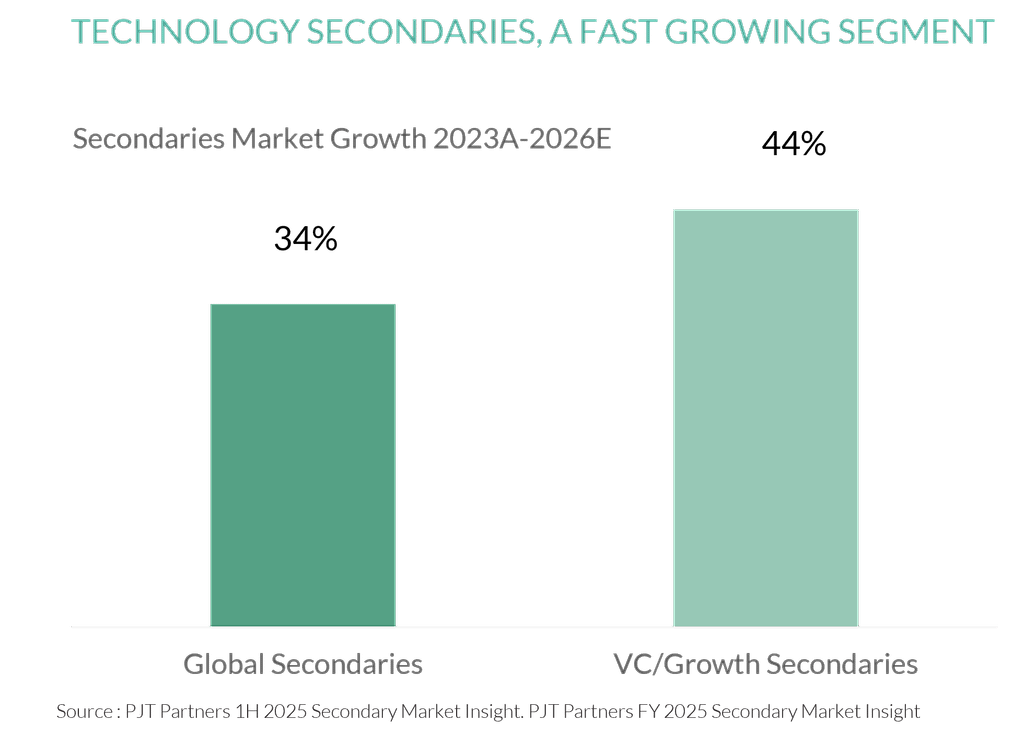
The technology secondary market remains in its infancy and is one of the fastest-growing segments within the secondaries market.
Technology secondaries: unlocking the flywheel
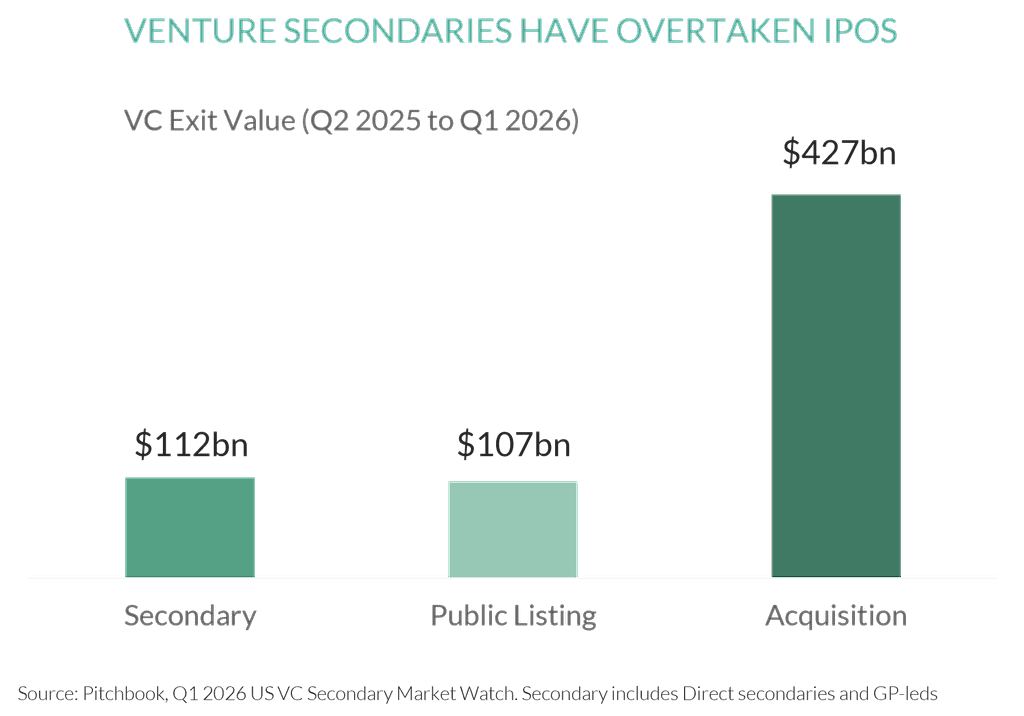
The numbers tell the story: transaction volumes have grown fast, and, in the US, venture secondaries have recently overtaken IPOs as the primary source of VC liquidity for the first time. Despite this, the technology secondary market remains in its infancy and is one of the fastest-growing segments within the secondaries market.
Technology secondaries: a compelling investment opportunity
Beyond their significance to the sustainable growth of the European technology ecosystem, we believe technology secondaries represents one of the most attractive opportunities in private markets today. The need for liquidity is vast, and the pool of dedicated capital remains tiny. That imbalance has created substantial discounts to fair value at the same time as offering access to some of the most exciting companies of our generation such as Revolut and Vinted.
Furthermore, investors increasingly see technology secondaries as a stand-alone niche within the overall secondaries market and have begun to develop dedicated allocations to the space. Like more established buy-out secondaries, according to us technology secondaries offer the advantages of greater diversification and accelerated liquidity. However, in addition, they provide investors with the opportunity to invest in many of the most successful new generation of tech leaders, thereby offering the potential of higher overall returns driven by the hyper-growth of many of those companies.
We expect the tech secondary industry to establish itself as an essential tool to fund Europe’s innovation.
Given the size of the market opportunity and the asset class’s strengths, we expect the tech secondary industry to continue to grow for many years ahead at the same time as establishing itself as an essential tool to fund Europe’s innovation. Investors should be aware that this strategy involves risks, including the risk of capital loss.
The strategy is exposed to a risk of capital loss. This communication does not constitute investment advice.
1 Includes Tibi Initiatives, KFW WIN Initiative, EIF’s Scale Up Funds, EIF’s ETCI funds.
2 Cambridge Associates BenchmarkUno standard di confronto del successo di un investimento. I benchmark sono spesso indici di mercato o una combinazione di più indici che guidano gli obiettivi d’investimento e l’universo d’investimento. – Venture Capital – Q4 2025
3 Based on Preqin data as of December 2025
Autore


