
The changing face of global venture capital


How the VC playbook is being rewritten: from global expansion to strategic concentration
The venture capital industry was built on a simple premise: funding innovation and driving growth. Today, it is increasingly financing something else: strategic capabilities. As AI reshapes technology, geopolitical tensions redraw investment flows and liquidity becomes scarcer, venture capital is entering a new chapter defined by concentration, sovereignty and scale.
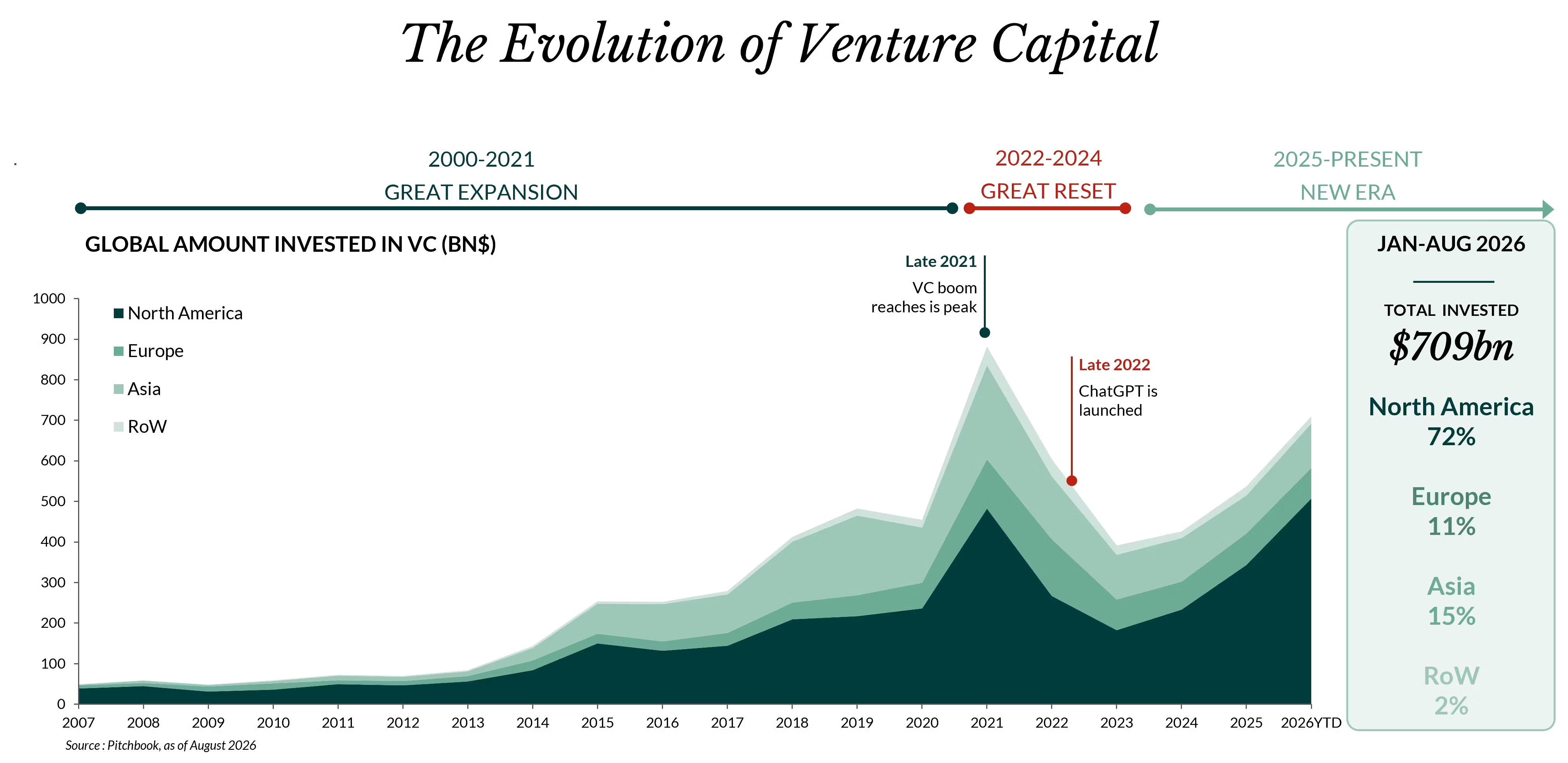
The Great Expansion (2000-2021)
The two decades following the dot-com crash marked an extraordinary expansion of venture capital, driven by four forces: technological innovation, globalisation, institutionalisation and abundant capital.
The globalisation of innovation
The United States remained the industry’s centre of gravity. Successive innovation waves, from the internet and e-commerce to smartphones, cloud computing and Software as a Service (SaaS), produced companies such as Google, Amazon, Facebook, Salesforce, Uber and Airbnb, reinforcing venture capital’s role as a catalyst for innovation and growth.
At the same time, venture capital became increasingly global. China emerged as the first technology ecosystem capable of challenging US dominance. A vast domestic market, rapid digital adoption, supportive policies and abundant capital enabled companies such as Alibaba, Tencent, ByteDance and Meituan to reach extraordinary scale.
Europe followed a different path, building innovation hubs across London, Paris, Berlin, Stockholm and Amsterdam. Strong universities, engineering talent and a growing entrepreneurial culture produced companies such as Spotify, Adyen, Klarna, Revolut and Booking.com, establishing Europe as a credible third pillar of the global technology ecosystem.
India and Southeast Asia also gained momentum, while technology’s borderless nature enabled startups to target global markets from day one and investors to follow innovation wherever it emerged.
The institutionalisation of venture capital
As opportunities expanded, venture capital evolved from a specialist activity into a recognised institutional asset class. Pension funds, sovereign wealth funds, endowments and insurers increased allocations, attracted by access to innovation and potentially strong returns. Fund sizes grew, fundraising accelerated and venture capital became a core component of private market portfolios.
The peak of the cycle
The expansion culminated in 2020 and 2021. The Covid-19 pandemic accelerated digital adoption, while ultra-low interest rates and abundant liquidity created exceptionally favourable conditions for venture investing. Capital flowed into technology companies at record pace, valuations surged and financing rounds reached unprecedented levels. By the end of 2021, venture capital had reached the peak of a two-decade cycle driven by globalisation, liquidity and abundant capital.
Then the regime changed.
The Great Reset (2022-2024)
The venture capital boom of 2020 and 2021 was built on exceptional monetary conditions. As inflation surged and interest rates rose sharply in 2022, investors rapidly reassessed the value of long-DurationLa duration è una misura della sensibilità che descrive il periodo di tempo medio in cui il capitale è vincolato in un titolo a reddito fisso. Si misura in anni. La duration è inferiore alla scadenza residua perché il periodo di ammortamento è ridotto dai pagamenti d’interesse intermedi sul capitale investito. Per le obbligazioni zero-coupon, la duration è pari alla scadenza residua, poiché i pagamenti d’interesse avvengono implicitamente solo alla scadenza. Sono quindi particolarmente sensibili ai tassi d’interesse. growth assets.
The impact was immediate. Technology stocks corrected sharply, private valuations declined, IPO markets largely closed and growth financing became significantly harder to secure.
More importantly, investor priorities changed. For much of the previous decade, growth often took precedence over profitability. That mindset shifted abruptly. Revenue quality, margins, capital efficiency and the path to positive cash flow returned to the centre of investment decisions.
The adjustment, however, extended beyond valuations. As IPO activity collapsed and M&A slowed, a deeper issue emerged: a growing gap between capital deployment and liquidity generation. Venture-backed companies continued raising capital and remaining private for longer but exits failed to keep pace. Distributions slowed, fundraising became more challenging and holding periods lengthened across the industry.
At the same time, a more structural shift was underway. The pandemic exposed vulnerabilities in global supply chains, while the war in Ukraine reinforced the importance of resilience and strategic autonomy. The competition between the US and China around semiconductors, artificial intelligence and other critical technologies intensified.
Technology was increasingly viewed not only as a source of growth, but as a matter of national security and economic sovereignty. The globalisation narrative that had defined the previous two decades was giving way to a more fragmented world in which technology, capital and geopolitics were becoming increasingly intertwined.
The new face of venture capital
AI Is driving recovery and concentration
Artificial intelligence has attracted venture capital for more than a decade, but the emergence of generative AI marked a genuine inflection point. The impact on venture capital took time to materialise. The industry was still digesting the 2022 correction, liquidity remained constrained and fundraising conditions were challenging. As AI adoption accelerated, however, capital increasingly concentrated around the sector.
By 2025, AI had become the primary engine of venture capital’s recovery. In many respects, AI did not simply revive the market after the reset: it redefined its centre of gravity. Venture investment increasingly flowed towards foundation models, semiconductors, computing infrastructure and AI-enabled applications, while a small number of companies absorbed an unprecedented share of available capital.
Unlike previous software waves, frontier AI requires enormous investments in computing power, specialised talent and energy infrastructure. The scale of financing increasingly resembles infrastructure projects rather than traditional software startups.
Sovereignty is reshaping investment priorities
At the same time, technology has become a strategic asset.
Governments now view semiconductors, artificial intelligence, cybersecurity, defense technologies, energy infrastructure and critical digital systems as essential components of national competitiveness and security. As a result, industrial policy has returned to the forefront of technology investing.
One of the most visible consequences has been the rise of defense technology as a mainstream venture category. Defense, aerospace, cybersecurity, space technologies and dual-use applications are attracting growing amounts of private capital as technological capabilities become increasingly important to national resilience. Energy is also moving closer to the centre of the venture ecosystem. The rapid expansion of AI is creating unprecedented demand for computing capacity, making data centres, electricity generation, grid resilience and semiconductor supply chains increasingly strategic investment themes.
Venture capital is no longer solely financing innovation. It is increasingly financing strategic capabilities.
Deglobalisation is redrawing the venture capital map
A natural consequence of technological sovereignty has been the gradual fragmentation of the global venture ecosystem. For much of the previous two decades, technology was one of the most globalised industries. Investors deployed capital across borders and startups increasingly operated internationally from the outset.
That trend is reversing. The relationship between the United States and China provides the clearest example. Geopolitical tensions and restrictions on strategic technologies have reduced cross-border investment flows, while several major venture firms have separated their US and Chinese operations. China’s venture ecosystem remains one of the largest in the world, but it is becoming increasingly self-reliant, supported by domestic investors, government-backed funds and national strategic priorities.
Europe is following its own path. Public and private capital are being mobilised around semiconductors, AI infrastructure, cloud computing, defense and energy resilience, reflecting a growing desire to strengthen technological autonomy.
The result is not the end of global venture capital, but a more fragmented ecosystem in which capital increasingly follows geopolitical interests and strategic priorities.
Challenged fundraising environment
Despite a recovery in investment activity, fundraising remains difficult for venture capital managers. Slower exits and weaker distributions have constrained LP liquidity, limiting their ability to make new commitments. Investors have become more selective, increasingly favouring established franchises with proven track records and scaled platforms.
As a result, fundraising is becoming highly concentrated. By 2025, nearly 60% of US venture capital fundraising was captured by just ten firms, making it increasingly difficult for emerging and mid-sized managers to raise capital. Venture capital is now concentrating at both the company and GP levels: just as AI is driving capital toward a handful of category leaders, fundraising is increasingly flowing to a small number of dominant managers.
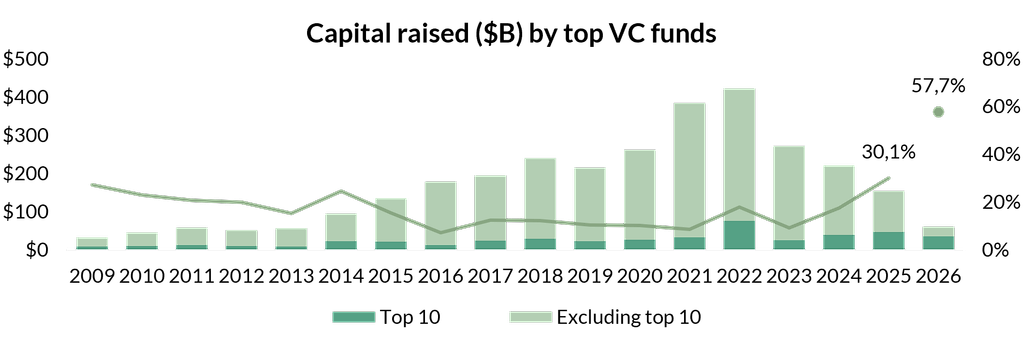
Source: Pitchbook, March 2026
The rise of the secondary market
The other defining feature of today’s market is the growing disconnect between capital deployment and liquidity. While investment activity has recovered, exit activity remains well below 2021 levels. IPO markets have reopened only selectively, and many venture-backed companies are choosing, or are able, to remain private for longer.
This liquidity gap has accelerated the development of the secondary market. Once viewed as an opportunistic liquidity tool, secondaries are increasingly becoming a core component of private-market infrastructure. The numbers tell the story: transaction volumes have grown fast, and, in the US, venture secondaries have recently overtaken IPOs as the primary source of VC liquidity for the first time.
The strategy is subject to the risk of capital loss. This communication does not constitute investment advice.
Autore


